
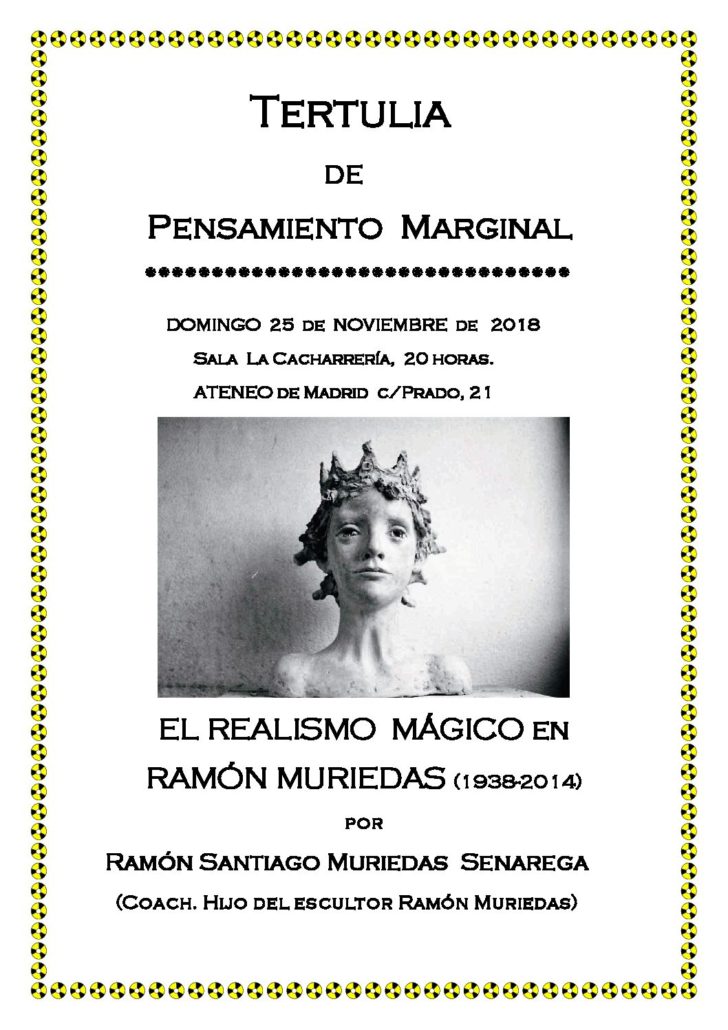
Lecture: Magical Realism in Ramón Muriedas
Venue: Sala de la Cacharrería, Ateneo Madrid. Calle Prado, 21, Madrid
Date: November 25, 2018
Time: 8:00 p.m.
The Ateneo de Madrid opens its doors to the figure of the sculptor Muriedas on the fourth anniversary of his death. The sculptor’s son will speak about his work in “Magic Realism.”
PRESS RELEASE, ENTRELETRAS DIGITAL MAGAZINE
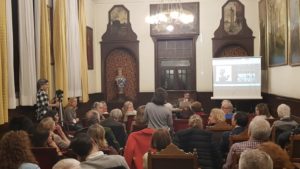
“Successful Lecture on Sculptor Ramón Muriedas at the Ateneo of Madrid”
By Juan Luis Álvarez / November 2018
In the “Sala de la Cacharrería” (Cookware Room) of the Ateneo, packed with an audience eager to learn about the sculptor on a personal and artistic level, his son, Ramón de Muriedas Senarega, gave a lecture entitled “The Magical Realism of Ramón de Muriedas” on the occasion of what would have been his 80th birthday and four years after his death. Afterwards, a discussion took place among the attendees, who praised his genius and work as timeless, capable of resonating with all audiences because he was a “sculptor of humanity,” of emotions.
Ramón de Muriedas y Mazorra (1938-2014) is one of the leading exponents of “Magical Realism in Sculpture” and received more than 15 National and International Awards. In the late 1950s, he began exhibiting his work, with milestones such as his participation in the Spanish Pavilion at the New York World’s Fair, the International Exhibition of Arts in Europe (Brussels), and the Zaragoza Art Biennial. It was in the 1970s that he established himself as a leading sculptor, exhibiting at prestigious events such as the 3rd International Exhibition of European Sculptors at the Museum of Contemporary Art in Madrid, the Alexandria International Art Biennial, and the Budapest Biennial (where he won medals for Spain), along with exhibitions in Paris. In the 1980s, he participated in exhibitions at the National Library of Spain in Madrid, the Royal Mint of Spain, the Casa Velázquez, and in Houston, Texas.
Among other distinctions, he was named an Academician of Fine Arts of Brazil (1970), as was the world-renowned Henry Moore. He created such important works as the “Sculptural Ensemble” at the headquarters of the Official State Gazette (BOE) in Madrid, “The Mother of the Emigrant” in Gijón, and “The Child Neptune” on the promontory of Camello Beach in Santander, currently undergoing restoration. His work is scattered throughout major museums such as the Reina Sofía and the Rio de Janeiro Museum, institutions such as the Ministry of Education and the US government, and private collections such as the Azcona Collection, to name a few.
The son of the prestigious sculptor stated that Muriedas, in terms of substance, “goes beyond reality, endowing his characters with their own soul through the expressiveness and gaze of his figures”; in the words of Csorba Geza, Director of the Hungarian Academy of Fine Arts, “he relates it to the Giacometti method, for whom the figure is not an object, but an examination.”
The recently deceased art critic Francisco Calvo Serraller, in the prologue to the catalogue for the General Directorate of Fine Arts, notes that “he sees everything from a familial perspective, enveloping stories with condescension, with tenderness. Herein lies the possible key to that recurring formula of magical realism, to his effusive way of contemplating the anonymous poetry of everyday life. This shaper of dreamy and fragile creatures is, therefore, not at all disoriented.” Antonio López met him at the FIAC in Paris and served on the Jury of the College of Civil Engineers alongside such distinguished figures as Eduardo Chillida, José Antonio Fernández-Ordoñez, and Eduardo Torroja. In a 2017 interview, he remarked that “he was an artist with a unique language who received considerable recognition but, over time, fell into oblivion.”
The multi-award-winning architect Juan Navarro Baldeweg, a friend and apprentice of certain notions of sculpture alongside Muriedas, acknowledges that “his figuration is anchored in childhood and the image of the ideal is in his imagination as an escape from harsh reality.” In a July 2018 article in the prestigious Ibero-American digital magazine Letralia, writer Ricardo Martínez-Conde notes that “he is a sculptor whose intelligence and expression lie somewhere between introspection and dreams; his sculpture is both real and intelligent, sentient, to use Zubiri’s expression.” Finally, according to Fuencisla Miguel, an art historian, his figures possess a rigid internal structure, a meticulously crafted harmonic and formal perfection, which then culminates in an apparently free, elusive, and carefree air.
The event concluded with a request for a posthumous public tribute from the government. A petition was launched on www.change.org by family and friends, and nearly 1,000 signatures have already been collected.

